

How To Remove The Rotator Preview Images In Joomla Panacea Template
Templates are merely a group of XML, PHP, HTML and image files that are stored in the templates directory of your site. You can edit these files directly or use the Template Manager.
Before You Begin [edit]
Before you start hacking away at a default installed template or any other template you may have installed, think that whatever updates of the Joomla core files may comprise new copies of the default Joomla templates. Similarly, editing an installed template means you may have to re-install it to reset it to the original state at installation.
Unless you take steps to protect your work, modifications could exist lost when upgrading Joomla. Likewise, y'all may desire to preserve an installed template in case you have any problems with modifications to information technology.
In that location are options in the Template Managing director to Duplicate and Re-create an existing template style or the actual template and template files. This page refers to the methods available to make a total re-create of your template. This includes the fashion and all the template files of a template.
Template Fashion and Template copying are not the same. You can brand a copy of the template fashion but yous are not protected from overwriting the actual template files. Style copying only adds another entry made in the _template_styles table of the database. This is useful is you desire to cheque a web site design with different fonts, colors, widths or logos if these template style parameters exist. The template files are not duplicated into some other uniquely-named directory and they will exist overwritten during an upgrade.
Copy the Template [edit]
To preserve your changes you need to Copy the template with all its files and styles. This process makes references to creating a full copy (an exact indistinguishable) of the template including all the files. In order to make a copy, you must exist on the Customise Template view.
At that place are two methods bachelor for accessing the Template Director: Customise Template. The Customise Template interface allows for editing the bodily code found in the template files, creating template overrides and template file manipulation.
1-Click or Switch to Template View [edit]

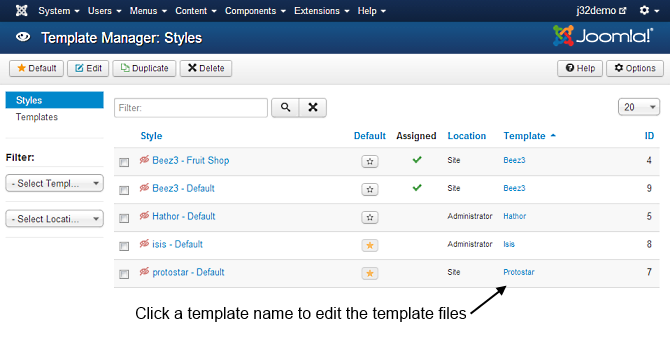
Styles column refers to changing the bachelor parameters of a template, such as color, font-color, logo, etc. These are dependent on the parameters a template maker made available and are a convenience for quick changes. Template - column refers to editing the actual template files.
To access the Template Customise feature:
- Straight - Click the template name in the column Template
- Indirectly - Styles will be highlighted, click on Templates beneath it which will turn the view to Template Manager:Templates, meet image below.
-
-
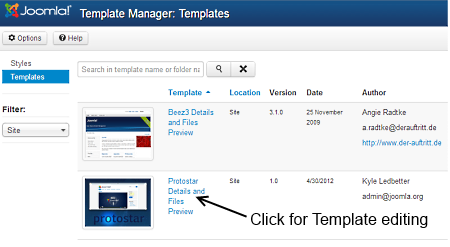
- Select the template yous wish to modify which will change the view to Template Director: Customise Template view
-
Customisation View [edit]
You should now exist looking at the epitome below, Template Manager: Customise Template.

Copy an Existing Template [edit]
The Easy Fashion [edit]
Create a new template by copying an existing template:
- Click on Copy Template in Toolbar in Template Manager: Customise Template view.

- Provide a new proper name and click on Copy Template
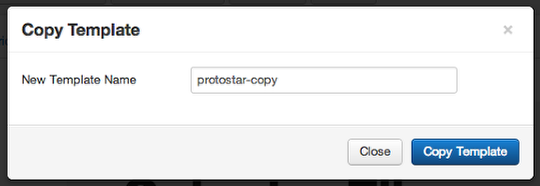
- The template is completely copied. This includes styles and all the template files.
Manually [edit]
- Create a new /templates/my_template directory.
- Copy the contents of the original template directory to the my_template directory.
- Go to the root /language/en-GB directory.
- Copy /linguistic communication/en-GB/en-GB.tpl_original_template.ini to en-GB.tpl_my_template.ini
- Re-create /language/en-GB/en-GB.tpl_original_template.sys.ini to en-GB.tpl_my_template.sys.ini
- Go to the /linguistic communication/en-GB directory in the template'south directory, if information technology exists.
- Copy /language/en-GB/en-GB.tpl_original_template.ini to en-GB.tpl_my_template.ini
- Copy /linguistic communication/en-GB/en-GB.tpl_original_template.sys.ini to en-GB.tpl_my_template.sys.ini
- Open the templateDetails.xml file in the my_template directory and change all references, if they exist, for the original template directory to the new directory my_template.
<language tag="en-GB">en-GB.tpl_my_template.ini</language> <language tag="en-GB">en-GB.tpl_my_template.sys.ini</linguistic communication> <param name="template_header" type="folderlist" directory="templates/my_template/styles/header" default="" label="Header Templates" description="HEADER TEMPLATES Clarification" /> <param name="template_background" blazon="folderlist" directory="templates/my_template/styles/groundwork" default="" label="Background Templates" description="BACKGROUND TEMPLATES Clarification" /> <param name="template_elements" type="folderlist" directory="templates/my_template/styles/elements" default="" label="Primary Elements" description="PRIMARY ELEMENTS DESCRIPTION" /> Discover the New Template [edit]
When manually copying a template, the new template must be introduced to your Joomla site through the discovery process.
- Become to Ambassador → Extensions → Extension Manager → Discover
- Click the Discover icon.
- Select your new template.
- Click Install.
If successful, the new template volition now be bachelor in Administrator → Extensions → Template Manager
- Make the new template the default template.
- View the site to verify it.
Finding Errors [edit]
You might have bug as a result of copying an existing template to a new template. Considering of the mode that Joomla handles file names, you might be tripped upward by a capitalization fault, for example.
Joomla contains some useful debugging tools. To see what is happening while working on a site, there are three settings that yous should modify.
- Assistants > Site > Global Configuration > System > Debug Settings > Debug System > Yep (Default = No)
- Administration > Site > Global Configuration > System > Debug Settings > Debug Linguistic communication > Yes (Default = No)
- Assistants > Site > Global Configuration > Server > Server Settings > Error Reporting > Maximum (Default = System Default)
With the Debug Linguistic communication set to Yes, for instance, you will see the success or failure of language file loading on each page of the Ambassador. Open up the Joomla Debug Console > Language Files Loaded console to view the study.

How To Remove The Rotator Preview Images In Joomla Panacea Template,
Source: https://docs.joomla.org/J3.x:Modifying_a_Joomla%21_Template
Posted by: lafleurfactiven56.blogspot.com
0 Response to "How To Remove The Rotator Preview Images In Joomla Panacea Template"
Post a Comment